
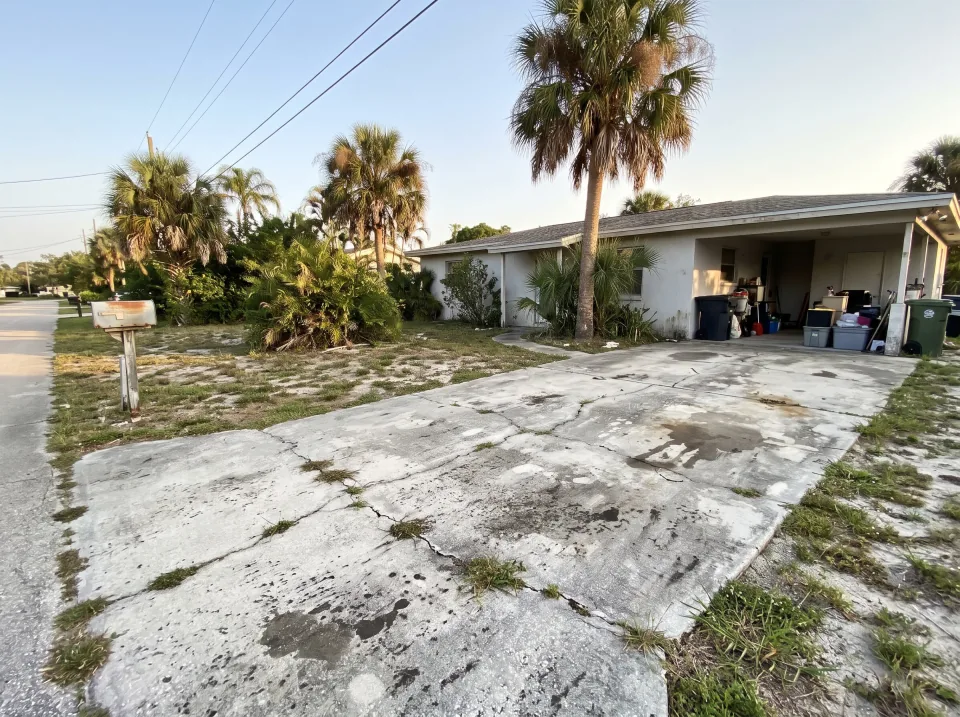

Driveway demolition cost in Broward and Miami-Dade comes down to the size, thickness, material and access of your driveway, which is why Rapid Haul prices it flat after a photo instead of quoting a number per square foot. Most people asking are about to replace a cracked slab or swap concrete for pavers and want to know what the tear-out side will run.
Below is how the price gets set, what makes it go up or down, what the city may require at the street, and what Rapid Haul does and does not do on a concrete removal job.
 01
How much does driveway demolition cost in South Florida?
Driveway demolition cost with Rapid Haul is one flat price set after a photo or a quick look, because driveways vary too much in size, thickness and material for one sticker price. The number covers breaking it out, loading, hauling and disposal, with nothing added at the end.
Dany would rather give you a real price for your driveway than a per-square-foot range off the internet. Text a photo to (754) 249-1015, with a rough size if you know it, and you will usually hear back the same day. Here is how the related prices work:
| Job | Price |
|---|---|
| Break out and haul an existing driveway | Flat price after a photo |
| Haul concrete already broken up and piled (construction debris) | From $200 |
| Other concrete removal | Flat price after a photo |
| Jobs of $1,000 and over | 50% deposit to hold the date |
 02
What changes the driveway demolition cost?
The driveway demolition cost changes mainly with the material, the thickness and steel, the area, the weight and the access. These are the things Dany looks at in your photo:
- Material. Pavers lift out and stack. Asphalt breaks up fairly easily. Poured concrete is the most work.
- Thickness and steel. Thicker slabs and slabs with rebar or wire mesh take longer to break and cut.
- Area. A short single-car pad and a long double driveway are not the same job.
- Weight. Concrete is heavy, and weight drives the number of trips to disposal.
- Access. Room to load near the street makes the job faster than carrying from the back of the lot.
- How much goes. Just the driveway, or the walkway and the apron at the street too.
 03
Do I need a permit to remove my driveway?
You may need a permit to remove or replace a driveway, especially the part near the street, and the city that covers your address decides. Miami Beach's Public Works FAQ says that if a driveway extends into the public right-of-way, a Public Works permit is required even when you already have a building permit, and that a Maintenance of Traffic plan may be needed if the work closes the sidewalk.
Other cities say the same thing in their own way. Sunrise lists driveway installation, replacement and expansion as typical single-family work that needs an Engineering Permit, and it says work that begins before an approved permit is charged a double fee. Fort Lauderdale handles driveway improvements through its Engineering Division, which publishes a Driveway Permit Package. Hollywood's permit forms include a Driveway Checklist and a Homeowner Affidavit for Driveway.
In unincorporated Miami-Dade, the county's driveway requirements for installing or modifying a driveway include a survey, a photo of the current condition, measurements of the new driveway, HOA approval where an association controls the area, and a recorded covenant for driveways other than asphalt or plain concrete, such as brick pavers or stamped concrete. Rapid Haul does not pull permits. Your GC or installer pulls it on a replacement job, or you do as the owner.
 04
Can you save my pavers?
Yes, Rapid Haul can stack your pavers for reuse instead of hauling them, as long as you tell Dany before the job. Pavers come up one at a time, and the sand base underneath may or may not need to go, depending on what the new surface needs.
Concrete and asphalt are a different job. A concrete slab gets broken into pieces small enough to lift, and any steel inside gets cut. Asphalt breaks up easier but makes a loose, messy pile. The EPA counts concrete and asphalt among construction and demolition materials, bulky and heavy waste that can be diverted from disposal, with aggregate as its main next use. Weight is the reason a driveway is priced differently from a pile of household junk.
 05
What we do and don't do on a driveway job
Rapid Haul breaks out the old surface, loads it, hauls it to disposal and leaves the area raked and swept. We don't pour the new driveway, lay new pavers or grade for drainage. That belongs to whoever is putting in the new surface.
Before the crew comes, move cars off the driveway and out of the way of the street side, and tell Dany about anything you know runs under or across it, such as sprinkler lines or a drain. If the new installer has a start date, share it, so the old surface comes out close to the day the new one goes in and you are not left with an open base through a week of rain.
That split keeps things simple. You or your GC line up the install and the permit, and we clear the old driveway on a date that fits the installer's schedule. If the driveway is only one part of a bigger tear-out, such as a patio, a shed or a pool deck, we price it together as one demolition job. We are insured with $1M general liability, and you get one flat, all-in price before anything gets broken.
 06
Where to start
First, call your city's building or engineering office and ask whether your driveway job needs a permit and who should pull it. If you are in an HOA, ask them too.
Then call or text Dany at (754) 249-1015, Monday to Saturday, 7 AM to 7 PM. Send one photo from the street and one from the house, and tell him the material if you know it. Smaller jobs are paid after the work, and jobs of $1,000 and over take a 50% deposit. Already broke it up yourself? That is debris hauling, from $200. Ready for the whole driveway? Start with our concrete removal service.
 4.9